Finding notes on the fretboard: why this is essential
Knowing the notes on the fretboard is essential for learning to play bar chords and scales and is simply must-know knowledge for any guitarist.
In communication with other musicians it comes in very handy as well.
It’s actually quite easy once you know how it works. This lesson will probably take you less than 30 minutes.
From there you can use it any time. At some point you just know the notes on your fretboard by heart.
Basicly what we will cover in this lesson is how to find all the notes existing in the Chromatic scale on the guitar fretboard, which holds all the 12 notes that exist in western music.
The Chromatic scale sounds like this if you’re interested. From low C to high C and back on the piano.
Now let’s get started.
We will keep it all simple and practical, as usual.
Let’s have a look at the piano as a reference guide
So first let’s have a look at the piano.
On the piano we see a repeating pattern of 12 different notes, going from left to right, low to high.
This pattern exists of white and black keys.
In each octave we see 7 white keys. These are the natural notes: C, D, E, F, G, A, B.
And in between we see 5 black keys. These are the sharp/flat notes: C#/Db, D#/Eb, F#/Gb, G#Ab, A#/Bb.
12 different notes on the piano in total.
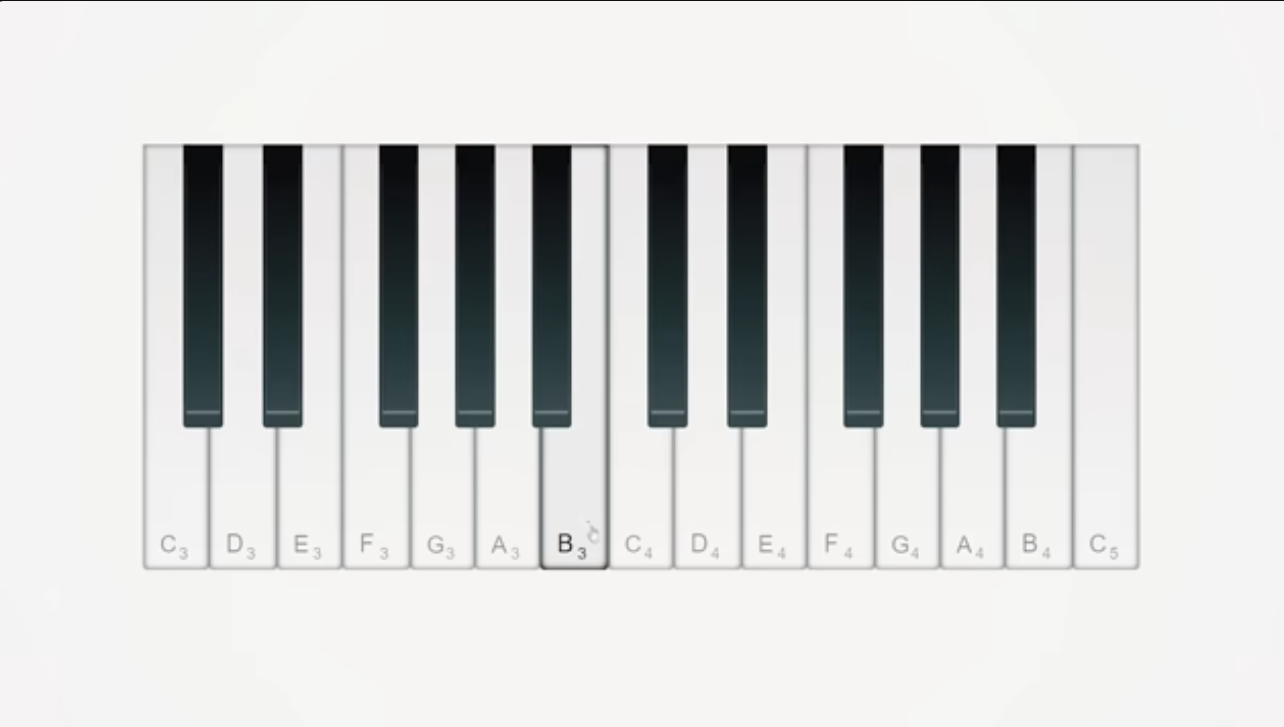
Two octaves on the piano. Image taken from a video from pauldavidsguitar.com
Notice there’s always one black key between the white ones, except for two places.
E and F.
B and C.
Remember these two exceptions.
This pattern of white and black keys in the same order repeats everywhere on the piano.
For example on a grand piano with 88 keys, we have this pattern repeating 7 times (plus three extra low notes on the very left).
Finding notes on the guitar
The same notes on the piano we can find on the guitar. The same white keys and the same black keys are present on the guitar.
Remember this:
On the piano in between the white keys is always a black key.
On the guitar theres always one fret in between. This one fret in between resembles the black key on the piano.
Two exceptions.
On the piano there’s no black key in between E and F and B and C.
So on the guitar theres no fret in between these notes.
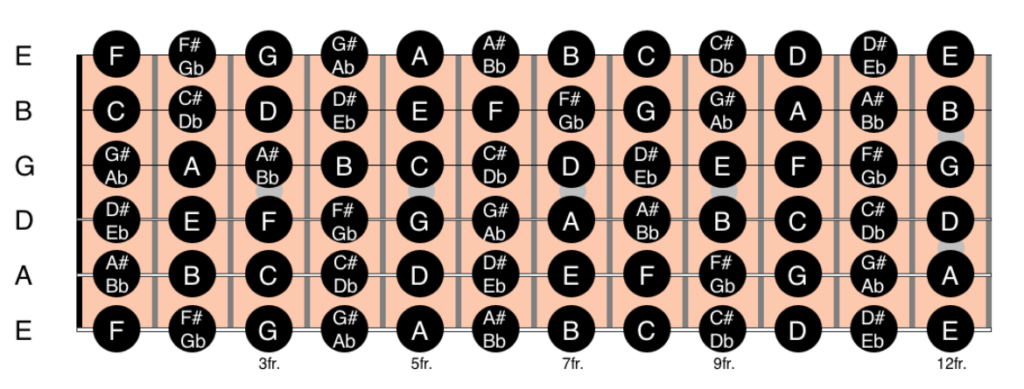
Notes on the fretboard. This image is from www.anyonecanplayguitar.co.uk.
Finding the natural notes on the E string
We’ll be learning how to find the natural notes on the thick E string. Natural notes are all white keys on the piano.
Natural notes on the E string: E, F, G, A, B, C, D.
Let’s go to the thick E string on your guitar.
Now let’s count up from open E to high E, checking only the natural notes.
E to F.
No fret in between (one of the exceptions).
F to G.
One fret in between.
G to A.
One fret in between.
A to B.
One fret in between.
B to C.
No fret in between (one of the exceptions).
C to D.
One fret in between.
D to E.
One fret in between.
Finding the black piano keys (sharps/flats) on the guitar
Now, still on the thick E string of the guitar. Let’s focus on the sharps/flats.
Let’s find a F# note.
Find the F note first. And move one up from there. There’s your F# note.
The same note is also named Gb.
Find the G note.
And then move one fret down to find the Gb.
Did you notice it’s the same note? Yes you did! 💪
Same note, different reference point.
Rule of thumb: find the natural note, then the sharp/flat is right next to it.
Two exceptions: between E and F and B and C.
Remember: on the piano there’s no black key in between these notes.
Which means on the guitar there’s no sharp/flat note right next to it.
They go right on to the next natural note.
Focus on the thick E and A string first
Once you know to find all notes on the E and A string you’ll know enough to start applying bar chords and scales. This should be your main focus as a beginner.
Some words of wisdom on using sharps and flats in music notation
Know that in a song there’s either sharps or flats, depending on the key. If you see both used in one song in any type of notation, you can tell the creator this is confusing. And please advice this person to study the subject of using sharps and flats in music notation.
Video example by Paul Davids
I found this lesson on the subject of finging notes on the fretboard by Paul Davids, who explains it quite well.
He uses the B string as an example, which works in the same way as any string, with just a different starting point.
I recommand learning the E and A string first though as mentioned.
You can skip the intro to 0.52 where the lesson starts.

Hope this helps. Keep on rocking! 🤘
Questions? Send us an e-mail!
Or enroll for a lessons in your own home or online.